

 Article and reviews by John Duncan
Intro | Model-by-model reviews
Sage Signal proves the thesis that it makes more sense to buy a mid priced rod from a high end rod maker than a high end rod from a mid priced manufacturer. Signal inherited the genetics of the famous Sage X, Salt HD and Igniter series, broadly considered among the finest fly rods in the world less than 5 years ago. Virtually unlimited by these materials, the Sage rod design team applied their highest discipline in taper design to the Signal series with the goal of owning the mid-priced saltwater fly rod category. They succeeded with honors. We prefer most of these models to the former high end Salt HD series, which were mimicked in the Signal’s immediate predecessor, the Maverick, with extra-stiff actions for maximum power and durability, but at the expense of lightness, taper refinement and approachability by the average angler.
Signal rods offer the following improvements over their forerunners in the Maverick series:
1) Lighter in the hand.
2) Power through line speed rather than stiffness.
3) Better engagement with the fly line, offering more control by the angler and a more forgiving casting action.
4) Greater fly line versatility. Most Signals will cast a wide range of fly lines without tripping up your casting stroke.
5) Pride of ownership – Signals are the most attractive and well appointed saltwater fly rods under $1,100 on the market. No contest.
Sage finished these rods appropriately, with a user friendly anodized reel seat featuring double lock rings for secure reel fit, Fuji ceramic stripping guides and oversized chrome snake guides, serious saltwater components that inspire confidence for long term durability and performance. Sage’s commitment to value carries over to their house-made partitioned cloth liners with sliding cord clasp and rod model printed on the liner for easy identity. The rods are packaged in a heavy duty powder-coated aluminum case with a beautiful Sage logo emblem.

Model-by-Model Review
Signal 690-4 (9′ 6-weight)
In my hands, the grip feels a little chunky for a 6-weight but the blank has an ethereal “airy” feel. It swings very light and sends the fly line without much resistance. The Rio Bonefish WF6 loaded the rod adequately for natural casting, but the rod may not deliver enough line speed to fish confidently on the flat. I would like to cast it with a Scientific Anglers Amplitude Bonefish WF6, which has a more sleek taper and might toss with more line speed. This rod casts progressively and pleasantly and would cross over well for trout streamers and bass, where the large grip supports an aggressive casting stroke. I would fish the Signal 690-4 for small and medium sized bonefish on a calm day, perhaps on Yucatan flats, but I probably wouldn’t take it to the Bahamas, Christmas Island or the Seychelles. This is a nice rod, but only elite saltwater 6-weights really belong on the flats.
Signal 790-4 (9′ 7-weight)
I intended to cast this rod with an SA Amplitude Bonefish 7-weight and I’m sure I’ll get around to it someday, but we had a Rio Smallmouth WF7 rigged and thought it would be a compelling freshwater line to test on the rod. The combination was a total show stopper. In fact, I would rate this rod and line among the finest casting of all 7-weight outfits. The Signal 790-4 and 890-4 may be considered a distinct sub-group of the Signal series. Both are strikingly light in hand. Both have lovely, light, progressive flexing tips that load automatically with sensitivity and a measured flex, reminiscent of the most refined high-end saltwater fly rods. Both send the line without inertia, and both generate power through line speed, rather than raw stiffness.
This is a true flats 7-weight that has enough bottom end stability to handle specialty trout streamer lines and articulated streamers. On the flat, fish this line with either a Rio or SA Bonefish taper. It’s up to the task for all bonefish, redfish up to 15 pounds and all similar saltwater gamefish. In both technology and taper refinement, this is a high end 7-weight fly rod.
Signal 890-4 (9′ 8-weight)
 Magnificent. Repeating myself with reference to the 790-4, The Signal 790-4 and 890-4 may be considered a distinct sub-group of the Signal series. Both are strikingly light in hand. Both have lovely, light, progressive flexing tips that load automatically with sensitivity and a measured flex, reminiscent of the most refined high-end saltwater fly rods. Both send the line without inertia, and both generate power through line speed, rather than raw stiffness.
I cast this rod with two lines, the Rio Elite Bonefish Plus WF8 and regular Rio Bonefish WF8. Both were terrific. With the Bonefish Plus, the rod generates the sweetest trout-to-saltwater loops imaginable, with tremendous zip coming from the natural load and recoil of the blank, effortless in the caster’s hand. The regular Rio Bonefish is 1/2 line weight lighter and allowed me to use a more aggressive double haul without generating a tailing loop. This line brings out a “high performance” nature in the rod, to borrow parlance from the Sage company. I preferred the Bonefish plus for casual casting, but both lines pair beautifully, which indicates that the Signal 890-4 will handle a wide range of lines, including most saltwater lines and freshwater lines such as the Rio Smallmouth and SA Infinity tapers. Fish this rod everywhere for everything that swims. I’m really impressed.
Signal 990-4 (9′ 9-weight)
The taper and casting action of this fly rod are well tuned to a Rio Bonefish WF9, but the Signal 990-4 lacks the sweetness and high-end refinement of the 7, 8 and 10-weights. It lacks the feel and feedback, but still delivers a terrific cast up to about 60 feet, beyond which it seems to lose line speed. The rod looks and feels durable, reliable and stable. You can really lean on it up to a certain distance and I feel like it would handle saltwater sinking lines and extra-heavy line heads better than the 7 or 8-weight. The 990-4 would be a better choice with a Rio Outbound Short, for example, or an overweighted freshwater streamer line for musky or pike such as the SA Titan Taper. It would also make an excellent jungle rod where aggressive line heads are used to cast larger flies for golden dorado and other species. These flies tend to be much larger than typical 9-weight saltwater flies, and the sturdy design of this fly rod would be well suited for the task.
Signal 1090-4 (9′ 10-weight)
This is one of my favorite models in the series and part of a 2-rod subset that are truly optimized for their line weights: the 1090-4 and 1190-4. The 1090-4 is everything I want from a 10-weight. The former Maverick 10-weight was considered one of the best rods in that series, but really stiff from tip to butt, more like an 11-weight. The new Signal 1090-4 is a much more refined fly rod. It casts with more engagement, loading perfectly with the length of the line head on the Rio Tarpon line. At short distances, it casts nicely off the tip, but the full line head taps a super springy mid section that launches the line to great distances with confidence, stability and authority in turning over the fly. It has plenty of butt section power for playing tarpon to 60 pounds, adult permit, roosterfish, king salmon, barracuda, dorado, false albacore, adult striped bass and mid-sized trevally. It holds the line very high on the backcast, ideal for roosters and stripers off the beach, and the stiff butt section will lift sinking lines with ease.
Signal 1190-4 (9′ 11-weight)
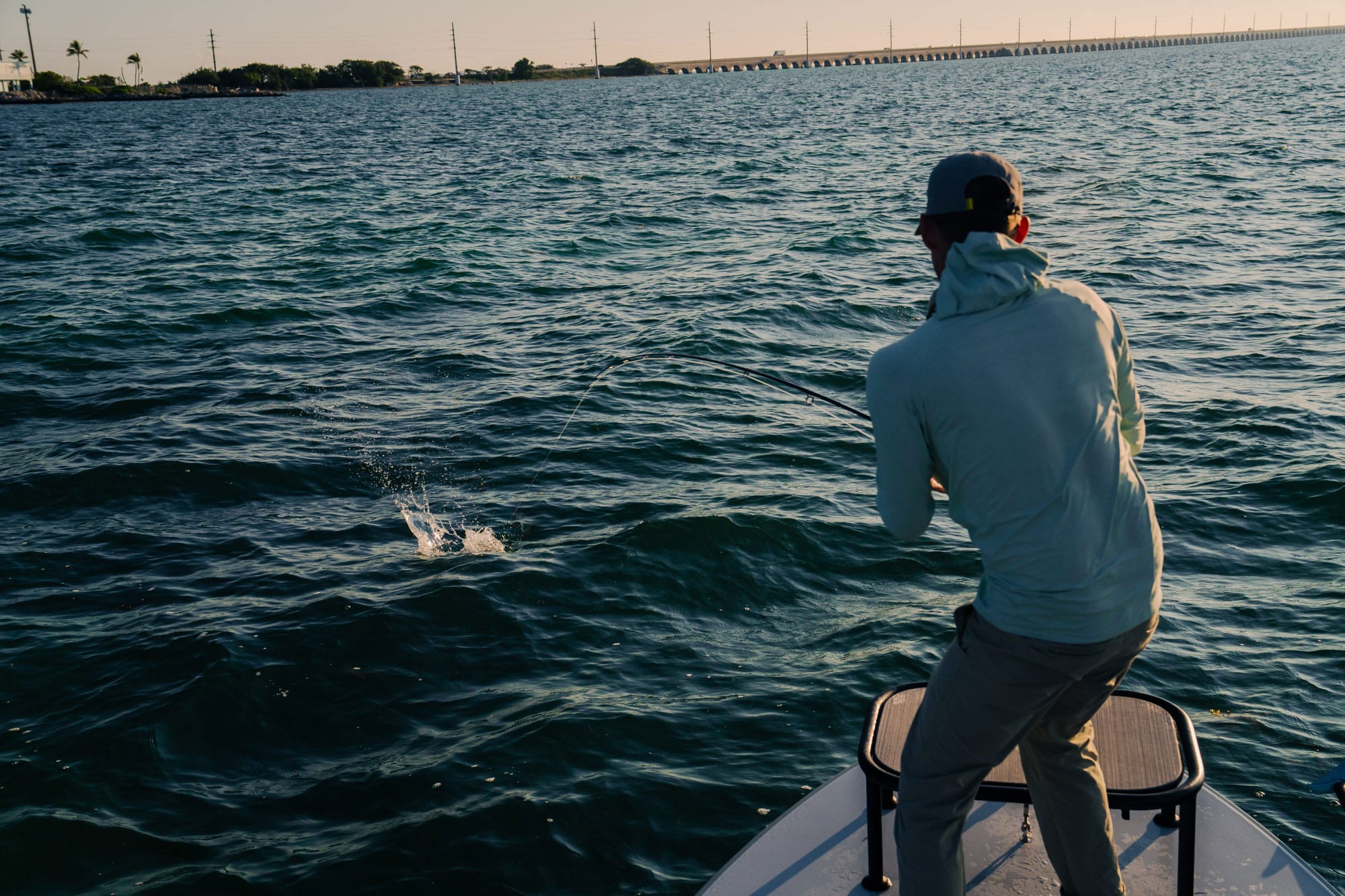 While not quite as light relative to its line weight as the 1090-4, I am equally impressed with this fly rod. The Signal 1190-4 is a serious tarpon rod in the hands of any angler. I cast it with a Rio Tarpon taper and found the pairing ideal for the combination of casting ease with line speed and distance. The tip engages well for short shots, but you can drive your cast easily to 80 feet. Like the 1090-4, I would call out the fact that the rod’s natural loading tendencies fit perfectly with the head length of a Rio Tarpon line. The playful tip transitions to a stiff butt section at the ideal moment when you have aerialized the full line head and need to shoot the rest. In addition to tarpon, the Signal 1190-4 is ideal for billfish and other hard-charging trophy saltwater gamefish.
Signal 1290-4 (9′ 12-weight)
This is a perfectly reliable 12-weight fly rod, but doesn’t quite have enough command to cast the extra-heavy Grand Slam line. Fish it with a Scientific Anglers Tarpon taper WF12 for highest line speed on the flat. The Signal 1290-4 has true 12-weight backbone for adult tarpon, billfish, tuna, sharks and giant trevally. The stiff butt section is adequate for those awkward GT lines, too, which tend to destabilize lesser 12-weights. Like other rods in the Signal series, this is a better pure casting rod than its predecessor, the Maverick 1290-4, which offered power through raw stiffness rather than casting engagement. The signal 1290-4 is not a lightweight fly rod, but much more castable and fishable than most other mid-priced 12-weights.